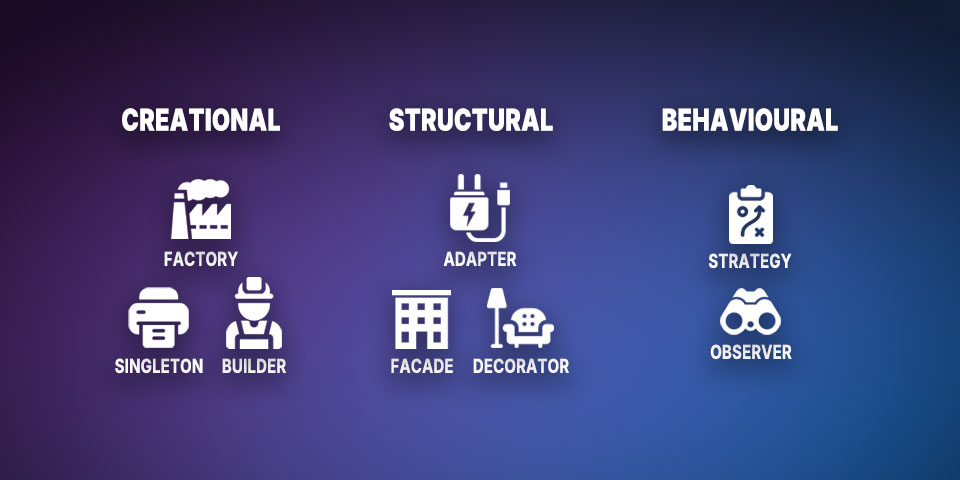
Software Design Patterns
Design patterns are tried-and-true solutions to common design problems. They aren’t code. They’re conceptual blueprints, templates you adapt to solve problems consistently across projects.
When you use them well, they make software easier to scale, easier to maintain, and easier to talk about with the rest of your team.
What they’re good for
Reusability. A pattern is a general solution. You can apply it across different problems without reinventing the wheel each time.
Adaptability. Patterns are templates, not finished products. You shape them to your project.
Shared vocabulary. When someone on the team says “let’s use a Factory here,” everyone knows roughly what’s about to happen. That alignment is half the value.
Maintainability. Code built around recognized patterns tends to be more modular. Easier to read, easier to refactor, easier to extend.
Not code. Worth repeating: a pattern is a recipe, not a meal. Don’t expect to copy-paste it.
OOP roots. Most of the classic patterns come out of object-oriented programming, where they solve problems around class structure and object behavior.
Patterns you’ll see often
- Singleton. One instance of a class, with a global access point.
- Factory Method. An interface for creating objects, where subclasses decide what to instantiate.
- Observer. A one-to-many relationship where dependents get notified when something changes.
- Strategy. Swap algorithms or behaviors in and out at runtime.
- Decorator. Add responsibilities to objects without modifying their code.
Why they’re worth knowing
You save time. You write clearer code. You communicate faster with the rest of the team. You break complex problems into pieces that fit together in predictable ways.
Patterns won’t solve every problem. Misapplied, they make things worse, not better. But when the situation calls for one, knowing the name and shape of it saves you from inventing a worse version under deadline.